
Learning about AI, Design, and Being an Outlier from Jake Knapp

Updated: Nov 9, 2025
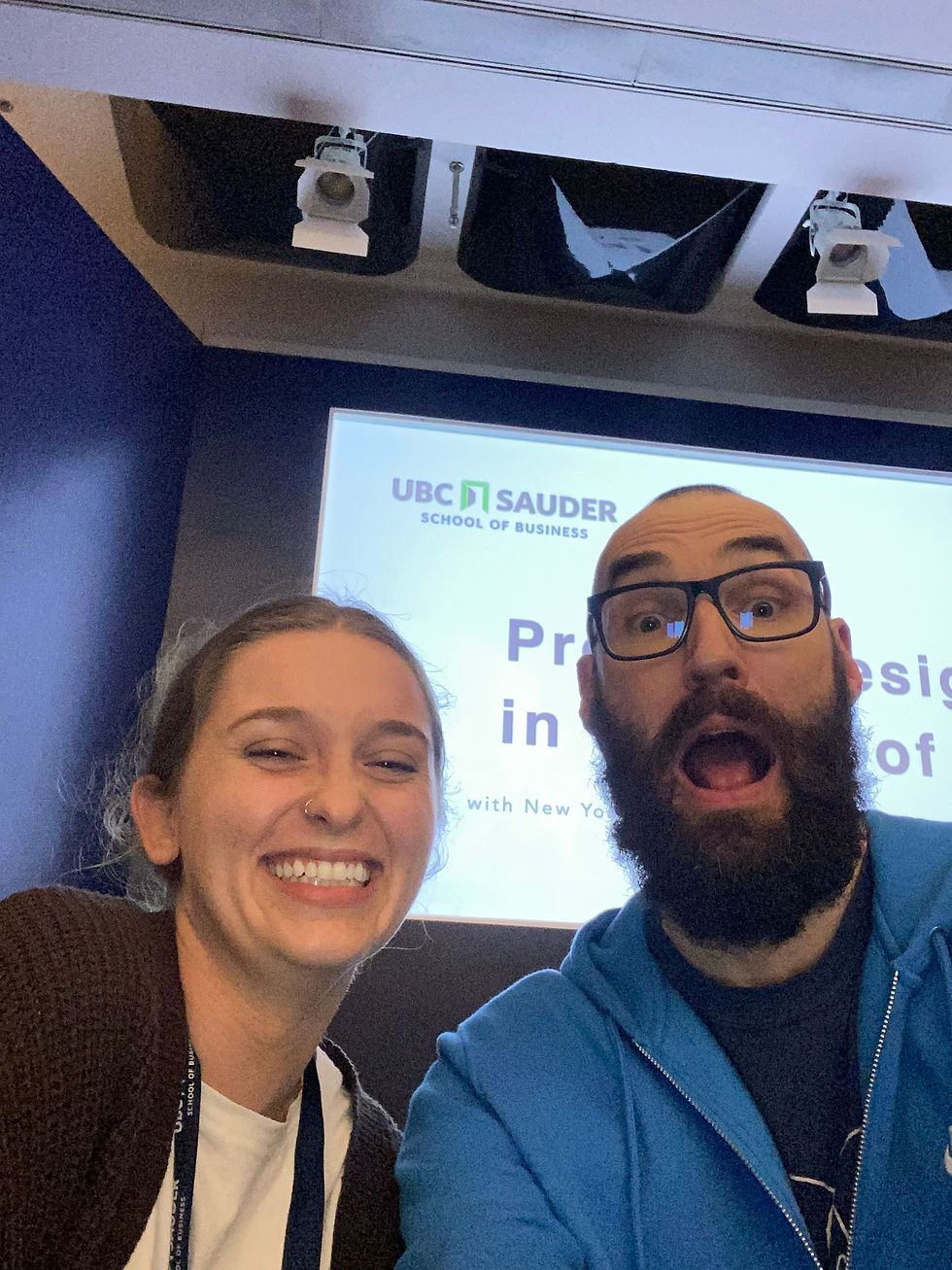
In September 2025, I had the chance to attend a presentation by Jake Knapp, author of Sprint and Make Time, and founder of Character Capital, where he spoke about product design in the age of AI. His talk was a mix of transparency, humor and optimism that left me feeling both challenged and inspired.
Stress, Excitement, and the AI “Sugar High”
Jake pointed out that with any big cultural shift like AI, it’s natural to feel stress. And if you’re not stressed, you’re probably excited, which is why companies are investing so heavily in it. That excitement though, can lead to what he called an AI sugar high: sky-high expectations followed by disappointment when the reality doesn’t measure up.
I found myself really connecting with this framing. The idea of an AI sugar high feels very accurate right now. Everywhere you look, platforms and websites are adding AI features. Sometimes they’re useful, but other times they don’t quite work as promised, and that can leave a negative impression. I know I’ve felt that subtle frustration when I encounter an AI feature that doesn’t actually improve the experience such as a chat bot that doesn't answer my question, or when a search engine give me an incorrect response.
Jake’s perspective helped me see an evident need more clearly: we need to remember that design decisions should always be grounded in real human needs, not just the novelty of a shiny new technology.
The power of outliers
Drawing on his experience working with teams at Google, Google Ventures, and now through Character Capital, Jake emphasized that product success comes from being an outlier. It’s not enough to simply improve on what competitors are already doing; customers won’t leave for a slightly better version. Breakthroughs happen when you redefine the problem in a way that encourages people to change their habits.
I couldn’t help but think about a shift I’ve witnessed myself, the move work communications made from email to Slack. Jake even touched on this in his talk, and it really resonated with me. Slack didn’t just make email better, it reinvented how teams communicate. For me, especially as a remote worker for several years, the difference was huge. Slack made collaboration easier, faster, and more natural compared to the clunky back-and-forth of email. It’s a reminder that real innovation happens when tools align with how people actually want to work.
Humans vs. AI: Who Brings the Outlier Perspective?
AI excels at providing well-optimized, generalized solutions... key word = generalized. But that’s not what sets breakthrough products apart. The outlier ideas, the ones that inspire lasting change, come from human perspective and creativity. That’s why Jake encouraged us to start on paper. Before touching AI, get clear on your own opinion and unique perspective. Use AI to build, test, or accelerate once you’ve set a strong direction, but don’t let it muddy your thinking at the outset.
Additionally, perhaps the simplest but most resonant part of Jake’s talk was his reminder: don’t give up. In an era of overwhelming competition, what makes you valuable as a designer or as a company is your unique perspective. AI can’t replicate our lived experience, way of reframing a problem, or opinionated choices.
While it's easier than ever to build something incredible using AI, the real challenge is to build something that people actually want to use. This requires team alignment, persistence, and a willingness to stick with your own point of view, even when the easier option is to let AI decide.
Personal Takeaways
Jake’s presentation hit home for me, especially given my own experience and where I’m at in my journey. I come to design from a completely different background than tech, nursing. More so than ever in this age of AI, it can feel discouraging to think about how others, with more traditional tech backgrounds, already seem positioned for success.
But Jake’s talk made me rethink this narrative. It helped me see that my experience and unique angle aren’t barriers — they’re strengths. They give me a perspective and understanding of people that’s different not only from other designers, but also from AI itself.
Yes, I feel the stress and pressure of this new era of AI. But I’m also extremely excited and optimistic. Combining my background, knowledge, and perspective with AI tools will only lead to stronger, more meaningful outcomes. My unique differences are exactly what bring value to the industry, and it's Jake who reminded me that it’s often the outliers who succeed.

Comments